
SCIP Panels vs ICF vs 3D Printed Homes The Best Way to Build a Concrete Home in Austin, Texas

If you're planning to build a home in Central Texas, you're likely asking one important question:
What is the strongest and safest way to build a home that will last?
More homeowners today are exploring concrete homes in Austin, TX because they want durability, protection, and long-term value. With rising insurance costs, severe weather events, and increasing maintenance issues in traditional construction, many families are reconsidering the materials used to build their homes.
As a concrete home builder in Austin, we see more homeowners and general contractors choosing concrete construction because they want a structure that can withstand fire, pests, moisture, and extreme weather conditions common across Texas.
This guide explains the difference between SCIP panels, ICF foam blocks, and 3D printed homes, and helps you understand which system provides the most reliable solution for building a long-lasting home.
Why More Homeowners in Texas Are Choosing Concrete Homes
Across Central Texas and the Hill Country, homeowners are increasingly choosing concrete house construction in Texas because of the protection and longevity it offers compared to traditional wood framing.
A properly built all-concrete home provides advantages that are difficult to match with wood construction.
Fire Resistant Homes
Concrete does not burn. In wildfire-prone regions of Texas, building with concrete significantly reduces the risk of structural loss.
Pest Resistant Homes
Termites are one of the most common and expensive problems in Texas homes. A properly built concrete home eliminates the risk of termite damage because insects cannot consume concrete.
Hurricane and Tornado Resistant Homes
Texas experiences severe storms every year. Reinforced concrete structures are widely recognized as one of the safest building methods available.
Energy Efficient Concrete Homes
Concrete construction combined with continuous insulation reduces air leakage and improves temperature stability.
Built to Last Generations
While wood homes typically require significant repairs within a few decades, properly built concrete houses can last well over 100 years—and in many cases, several generations.
What Does It Cost to Build a Concrete Home vs Wood?
Building an all-concrete home typically costs about 10–15% more than a traditional wood-framed home based on the overall budget of the home. If your budget is $1,000,000 then building an all concrete home (walls,roofs and midfloors) will add about $150,000 above the million dollar budget.
However, when evaluating the true cost of construction, it is important to consider long-term savings. Concrete homes often reduce insurance costs by 20%, maintenance costs, repair costs, energy costs, and storm damage risk.
The Three Most Common Concrete Home Building Systems
1) SCIP Panels or Structural Concrete Insulated Panels
2) ICF Foam Blocks
3) 3D Printed Concrete Homes
ICF Foam Blocks (Insulated Concrete Forms)
ICF construction is a widely used method for building concrete homes. The system uses foam blocks stacked together to form walls, which are then filled with concrete.

Advantages of ICF Construction
- Strong wall system
- Good insulation performance
- Familiar construction method
- Widely available materials

Limitations of ICF Construction
- The foam remains permanently on the outside and inside of the wall
This foam is subject to fire and pest.
- Interior are not practical to build using ICF. Typically these are used on Exterior walls only.
- Roof systems are still wood-framed- Making your entire home not fire, wind, water or pest resistant.
- Construction costs can be higher due to labor and material requirements
- Once the exterior ICF walls are complete you still need to wood frame your interior walls and install drywall. You effectively are doing double the amount of work.
3D Printed Concrete Homes
3D printing is one of the newest technologies in residential construction. A robotic printer applies layers of concrete to form structural walls.
Advantages of 3D Printed Homes
- Innovative building technology
- Reduced labor requirements
- Fast wall construction
- Strong concrete material
Limitations of 3D Printed Homes
- Limited availability in most markets
- Specialized equipment required- Large and costly equipment
- Engineering and code challenges
- 3d printed structures still rely on traditional framing for roofs and floors
- Long-term performance is still being evaluated
- Wall heights are for single story homes primarily.
- You're left looking at a very unsightly rippled wall on the interior and exterior, almost impossible to clean.
- Custom homes or one off homes would require a lot of set up and tear down expense, wall and window computer mapping.
- You still need to install insulation as an added expense.

SCIP Panels (Structural Concrete Insulated Panels)
SCIP panels are one of the most versatile and efficient systems available for building all-concrete homes. This system uses a continuous insulation core reinforced with steel mesh on both sides. Shotcrete is applied to each side of the panel, creating a solid reinforced concrete structure. Same strength as a rebar reinforced wall however with 6 inches of high performance EPS foam core. This foam allows for a completely thermally broken exterior wall and roof system. Offering better insulation than the best Yeti Cooler.
Unlike many construction methods, SCIP panels allow builders to construct the entire structural shell using concrete.
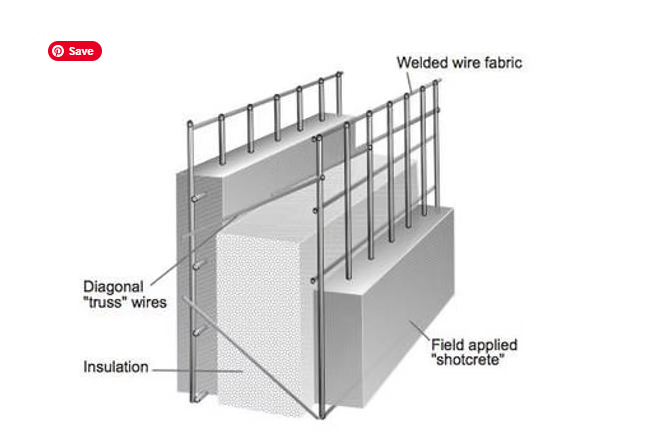
This includes:
- Exterior walls
- Interior walls
- Floors
- Roof systems
Why SCIP Panels Are the Strongest and Most Affordable Way to Build a Concrete Home
SCIP construction creates a continuous reinforced concrete structure that behaves as one unified system.
This design provides several key advantages:
True All-Concrete Construction
Many building systems use concrete for only part of the structure. SCIP panels allow builders to create a complete structural shell made entirely of reinforced concrete.
Continuous Insulation
Unlike wood framing, which includes studs every 16 inches that transfer heat and cold, SCIP panels provide continuous insulation across the entire wall system.
Strength and Durability
Reinforced concrete construction provides exceptional resistance to fire, termites, mold, high winds, and severe storms.
Long-Term Value
Building with SCIP panels allows homeowners to reduce maintenance costs, increase structural reliability, improve safety, and protect long-term property value.
Which System Is Right for Your Home?
Every project is different, but the decision often comes down to one simple question:
Do you want a house that lasts decades, or a house that lasts generations?
If you are planning to build in Central Texas and want maximum strength, safety, and longevity, concrete construction provides one of the most reliable solutions available.


Final Thought
You only build a home once.
Will you build it to last—or build it to rebuild?
Concrete Struksures is a local Austin Based company. We build structural shell homes for the discerning general contractor or home owner.
We build the only structure you will be sure about!


Comments